North America leads while Asia-Pacific accelerates fastest, as AI-powered detection reshapes the global counter-drone security landscape.
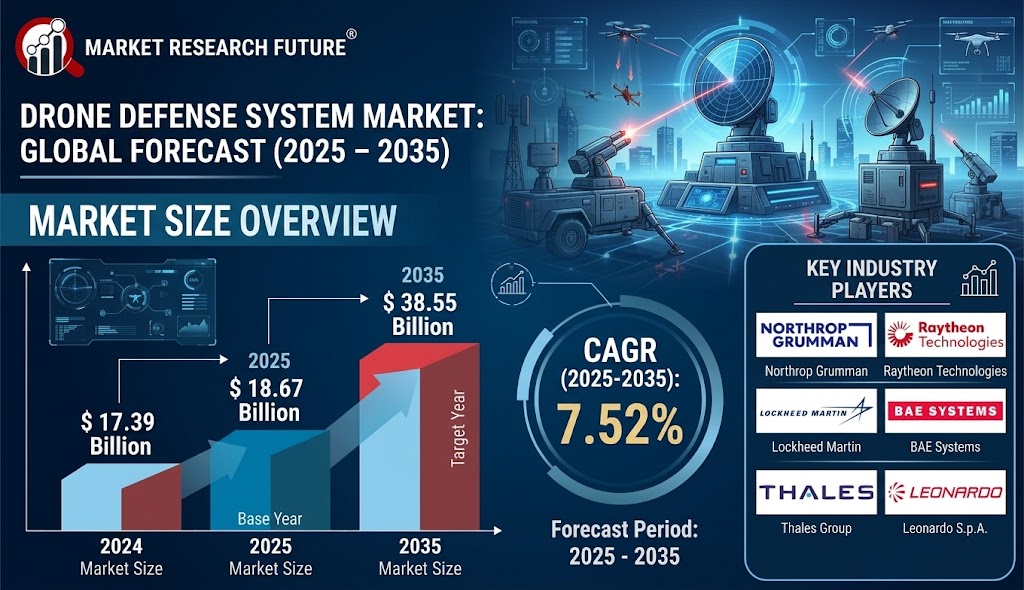
NEW YORK, NY, UNITED STATES, August 27, 2026 /EINPresswire.com/ — The global Drone Defense System Market, valued at an estimated USD 17.39 billion in 2024, is projected to reach approximately USD 18.67 billion in 2025 and climb further to USD 38.55 billion by 2035, according to a newly compiled industry analysis. The market is expected to advance at a compound annual growth rate of around 7.52% between 2025 and 2035, propelled by rising airspace security concerns, expanding military modernization budgets, and rapid advances in artificial intelligence-enabled detection systems.
The findings arrive at a moment when unmanned aerial vehicles have moved well beyond their traditional military origins into logistics, agriculture, media production, and large-scale public events, creating new categories of risk that governments and private organizations alike are now moving to address. What was once a specialized military procurement decision has become, in a growing number of jurisdictions, a baseline operational requirement for any facility or event that draws public attention or handles sensitive activity.
“Drones have become part of everyday commercial and civilian life, and that same accessibility has opened the door to misuse, whether intentional or accidental,” said a senior aerospace and defense industry analyst involved in the research. “What we’re seeing is a fundamental shift where counter-drone infrastructure is no longer viewed as a specialty military purchase but as a baseline security requirement for airports, stadiums, power plants, and critical infrastructure sites around the world.”
A Market Shaped by Converging Pressures:
Unlike many defense technology categories that grow primarily in response to geopolitical cycles, the drone defense system market is being pulled forward by several independent forces at once, each reinforcing the others. On one side sits traditional military demand, where armed forces are treating counter-unmanned aerial system capability as a core requirement rather than a discretionary upgrade. On the other side sits an entirely new category of civilian and commercial buyers who, a decade ago, would never have considered themselves customers for defense-grade security technology.
Request for Free Sample of Report: https://www.marketresearchfuture.com/sample_request/10331
This dual demand base is part of what gives the market its resilience. Even in years when defense budgets tighten, commercial adoption — driven by insurance requirements, corporate risk management, and public-safety obligations — continues to expand the customer pool. Analysts tracking the sector describe this as a maturing market moving from reactive purchasing, driven by isolated incidents, toward planned, budgeted procurement cycles built into standard security infrastructure.
Market Drivers Fueling Expansion:
Several converging factors are underpinning the market’s growth trajectory.
Defense modernization and military procurement. Armed forces in the United States, Israel, and a growing list of other nations continue to expand procurement of counter-unmanned aerial systems to protect troops, bases, and strategic assets. This segment of demand alone is expected to grow into a multi-billion-dollar category well before the end of the forecast period, as defense ministries fold counter-drone budgets into broader modernization programs rather than treating them as standalone line items.
Tightening regulatory requirements. Aviation authorities, including the U.S. Federal Aviation Administration, have introduced requirements for protective measures in designated high-risk airspace, effectively mandating deployment of detection and mitigation systems at sensitive sites such as airports and government facilities. Analysts say this kind of compliance-driven demand provides a stable growth floor that is largely insulated from swings in discretionary security spending, since it is tied to legal obligation rather than optional risk management.
Commercial sector expansion. Logistics providers, agricultural operators, and surveillance firms that rely on their own drone fleets are increasingly investing in protective systems to guard against unauthorized aircraft interfering with their operations. This has broadened the customer base well beyond government and military buyers, drawing in warehouse operators, stadium and venue managers, utility companies, and even large private estates seeking to protect against unwanted surveillance or intrusion.
Technological innovation. Artificial intelligence and machine learning are being layered into detection platforms to allow real-time analysis of sensor data, improving the ability to distinguish genuine threats from birds, weather interference, or other environmental noise. Industry watchers tracking this innovation segment separately note it is growing at a considerably faster pace than the overall market, with associated technology investment projected to expand at a CAGR above 25% through 2035 as sensor fusion, edge computing, and adaptive threat-classification models mature.
Rising incident frequency. High-profile incidents — drones disrupting flight operations at major airports, unauthorized aircraft flying over stadiums, prisons, or public gatherings — have made the risk impossible to ignore for policymakers and corporate security teams alike. “Every one of those incidents tends to accelerate budget conversations at both the government and corporate level,” the analyst added. “What used to take years to move through a procurement cycle now often gets fast-tracked once a visible incident makes headlines.”
Public-private collaboration. A growing number of programs pair government agencies with private technology developers, combining defense-grade engineering standards with the faster iteration cycles typical of commercial technology firms. These partnerships are shortening the time between concept and deployment for new detection and mitigation products, and are increasingly seen as a model other security technology categories may follow.
Segment Highlights:
The research breaks the market down along three core dimensions — system type, end-user, and region.
By system, the market splits into identification and detection systems, and countermeasure systems. Detection systems cover the radar, radio-frequency sensing, and electro-optical/infrared technology used to spot and classify an incoming drone, while countermeasure systems cover the jamming, kinetic, laser, and cyber-based tools used to neutralize a confirmed threat. Demand for countermeasure systems currently makes up the larger share of spending, reflecting the priority governments and enterprises place on being able to actually stop a threat once it is identified, while detection systems are seeing some of the quicker innovation as AI-enhanced sensors improve accuracy and reduce false alarms. Vendors report that buyers increasingly want the two categories sold as an integrated package rather than as separate procurements, since a detection system with no matching response capability offers limited practical value in an active threat scenario.
By end-user, the market is segmented into military defense, commercial, and homeland security categories. Military defense remains the largest end-user group by a wide margin, reflecting sustained national security budgets and the strategic importance of protecting troops, bases, and airspace from both state and non-state threats. The commercial and homeland security categories are growing at a faster clip, as corporations, airports, and public-safety agencies increasingly treat counter-drone capability as a standard part of their security posture rather than a specialized military purchase. Within the homeland security category, border-protection agencies and critical-infrastructure regulators are cited as particularly active adopters, often driven by new compliance mandates rather than voluntary upgrades.
By region, the market is tracked across Asia-Pacific, North America, Europe, and the Rest of the World, with regional performance and the forces driving each market detailed below.
Regional Performance:
North America retains its position as the largest regional market, with a 2024 market size estimated near USD 8.6 billion. The region’s leadership is supported by substantial defense budgets, an established regulatory framework, and a concentration of major system manufacturers headquartered in the United States. Continued investment from federal agencies, combined with growing demand from commercial airports and large public venues, is expected to keep North America at the top of the regional rankings throughout the forecast period, even as other regions grow at a faster relative pace. Procurement activity in this region is also being shaped by border-security modernization efforts and by a steady stream of contracts tied to protecting critical energy and transportation infrastructure.
Europe follows as the second-largest region, with a 2024 market size of roughly USD 4.1 billion. Growth here is linked to a rising number of drone-related security incidents, coordinated defense initiatives at the European Union level, and cross-border collaboration among member states on shared airspace-security standards. The United Kingdom, France, and Germany serve as the region’s leading national markets, each home to established defense contractors actively expanding their counter-drone product lines. Several European governments have also signaled intent to standardize counter-drone requirements across major public venues and transportation hubs, a move expected to further support regional demand.
Asia-Pacific, valued at approximately USD 3.0 billion in 2024, is identified as the fastest-growing region overall. Expanding military expenditure, heightened regional security tensions, and government-backed technology programs across India, Japan, and Australia are all contributing to this acceleration. Local manufacturing initiatives and technology-transfer partnerships with established Western and Israeli suppliers are also helping regional players build domestic counter-drone capability more quickly than in previous years, narrowing the technology gap with more established markets.
The Middle East and Africa region, valued at roughly USD 1.5 billion in 2024, continues to develop steadily as geopolitical tensions and infrastructure-protection priorities push governments in the UAE, South Africa, and neighboring countries toward greater investment in tailored counter-drone solutions. Analysts expect this region to see increasing activity as energy-sector and critical-infrastructure operators recognize their exposure to drone-based threats, particularly around oil and gas facilities that have historically been targeted in regional conflicts.
Competitive Landscape:
The market remains moderately fragmented, with competition spanning large diversified defense contractors and more specialized counter-drone technology developers. Companies named among the market’s key players include Northrop Grumman, Raytheon Technologies, Lockheed Martin, BAE Systems, Thales Group, Leonardo S.p.A., Israel Aerospace Industries, Elbit Systems, General Dynamics, and L3Harris Technologies.
Recent competitive activity illustrates the pace of innovation across the sector. Northrop Grumman has introduced a new line of counter-drone systems tailored for urban environments, addressing operational challenges specific to city-based security scenarios where traditional long-range systems are less effective. Raytheon Technologies has entered into a partnership aimed at strengthening AI-driven detection capability, positioning the company to improve real-time threat assessment across its existing counter-drone product lines. Israel Aerospace Industries has secured a supply agreement with a European nation, reflecting growing international demand for its counter-drone technology and reinforcing its presence outside its traditional home market.
“Competitive advantage in this market is shifting away from price and toward technological differentiation,” the analyst noted. “The companies pulling ahead are the ones investing in research, forming strategic partnerships, and building supply chains flexible enough to respond quickly to new customer requirements, whether that customer is a national defense ministry or a private airport operator.”
Beyond individual contracts, competitors are increasingly localizing manufacturing and diversifying their supplier networks to improve responsiveness to regional customers, while also pursuing alliances that combine complementary strengths — sensor technology paired with AI-driven software intelligence, for instance, or defense-grade engineering paired with the faster commercialization cycles typical of technology firms outside the traditional defense sector. Industry observers expect further consolidation among smaller detection-technology specialists over the coming years, as larger primes look to acquire niche AI and sensor capabilities rather than build them entirely in-house.
Outlook Through 2035:
Looking ahead, the Drone Defense System Market is expected to continue its expansion as airspace grows more congested with both authorized and unauthorized unmanned aircraft. Emerging opportunity areas include AI-powered detection algorithms capable of adapting to new and evolving drone tactics, integration of counter-drone infrastructure with smart-city security networks, and region-specific solutions designed for markets where drone adoption — and the associated security risk — is still in its early stages of acceleration.
Industry stakeholders anticipate that companies willing to invest early in adaptable, intelligence-driven platforms, while building strategic alliances across the public and private sectors, will be best positioned to capture growth opportunities over the coming decade. As regulatory frameworks continue to mature across additional jurisdictions and as commercial buyers become more comfortable with the technology, the distinction between “military-grade” and “commercial-grade” counter-drone systems is likely to blur further, opening the door to new product categories that did not exist even a few years ago. Analysts also point to the potential for counter-drone capability to become a standard line item in broader smart-infrastructure and public-safety technology budgets, rather than a specialized procurement handled separately from other security investments.
Browse More Reports:
Drone GIS Mapping Market
https://www.marketresearchfuture.com/reports/drone-gis-mapping-market-29760
Drone Navigation System Market
https://www.marketresearchfuture.com/reports/drone-navigation-system-market-40340
Drone Services Market
https://www.marketresearchfuture.com/reports/drone-services-market-9522
Market Research Future
Market Research Future
+1 855-661-4441
sales@marketresearchfuture.com
Legal Disclaimer:
EIN Presswire provides this news content “as is” without warranty of any kind. We do not accept any responsibility or liability
for the accuracy, content, images, videos, licenses, completeness, legality, or reliability of the information contained in this
article. If you have any complaints or copyright issues related to this article, kindly contact the author above.

Media gallery