
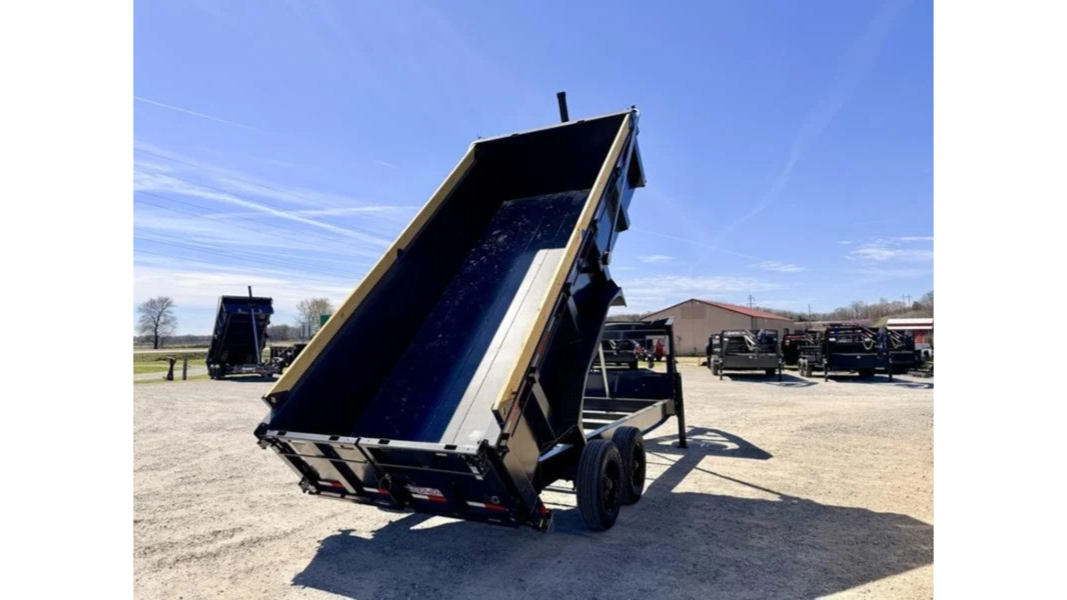
Key Takeaways
- Dump trailers for sale near St. Louis range from $7,488 for compact 6×12 tandem-axle units to $28,488 for premium 16-foot gooseneck configurations rated at 23,000 lbs GVWR, with price driven mainly by size, GVWR class, and feature upgrades
- Size matters more than most buyers expect: compact 10- to 12-foot trailers suit homeowners and light landscaping, 14-foot models are the pick most St. Louis contractors make, and 16-foot or gooseneck builds handle heavy commercial loads
- GVWR and payload capacity are the two numbers that determine whether a trailer can legally and safely handle a job, and understanding them prevents costly mistakes
- Dealers like Poplar Bluff Trailer stock dump trailers from major brands with daily-updated inventory and same-day financing approval for qualified buyers – making them well-placed to share the expert insights below
Shopping for a dump trailer in the St. Louis area means weighing price, size, and dealer options together, and getting any one of them wrong can mean overpaying or ending up with a trailer that cannot handle the job.
The market around St. Louis is well stocked, with options spanning homeowner-friendly compact units up to heavy-duty gooseneck rigs built for daily commercial work. So what’s the distinction between them?
Prices Range From $7,488 to $28,488
Dump trailers for sale near St. Louis span a wide price spectrum, starting around $7,488 for compact 6×12 tandem-axle units and climbing to roughly $28,488 for premium 16-foot gooseneck configurations rated at 23,000 lbs GVWR. That gap reflects real differences in capability, not just added markup. A trailer built for weekend mulch runs costs a fraction of one engineered to cycle heavy loads of concrete debris five days a week.
Three factors drive where a given trailer lands in that range: overall size, GVWR class, and the feature set bolted onto the frame. Buyers trying to figure out what a fair price looks like before they start comparing dealers can use these price bands as a starting reference point. Knowing the rough price tier for a given size and capacity ahead of time makes it much easier to spot a good deal versus an inflated one.
It helps to think of the market in three tiers rather than one continuous price line. Entry-level trailers, mid-range workhorses, and heavy-duty commercial builds each occupy their own price neighborhood, and knowing which tier matches a project’s actual needs prevents both overspending and underbuying.
Matching Dump Trailer Size to the Job
Picking the right size dump trailer starts with an honest look at what will actually be hauled, how often, and with what tow vehicle. Buyers who size up out of caution often pay more than necessary, while those who size down to save money sometimes end up overloading a trailer that can’t safely handle the work. The sizing conversation breaks down cleanly into three categories.
Compact 10-12 Foot Trailers for Homeowners
Compact dump trailers in the 10-12 foot range are built for homeowners, part-time landscapers, and contractors working tight residential lots. These models typically carry GVWR ratings between 7,000 and 10,000 lbs, enough to handle brush, light demolition debris, and yard waste without straining a half-ton or midsize pickup.
Their smaller footprint pays off in older St. Louis neighborhoods like Soulard, The Hill, and Tower Grove, where narrow driveways and tight alleys make a bigger trailer a headache to maneuver. For buyers stepping up from hauling loose debris in a truck bed, or looking to stop paying recurring rental fees on small projects, this class delivers solid value for the money. A model like the MAXX-D D7X7210, a 6×10 unit rated at 10,000 lbs with 4-foot solid sides, illustrates the kind of capability available at this size.
Mid-Size 14 Foot Trailers Favored by Contractors
The 14-foot dump trailer has earned its reputation as the workhorse size for serious DIYers and small to mid-size contractors across the St. Louis metro. GVWR ratings in this class commonly run from 14,000 to 17,500 lbs, giving enough headroom for heavier materials like rock, dirt, and roofing tear-off without stepping up to a commercial-class tow vehicle.
Tandem axle setups in this size class improve stability, braking, and payload capacity compared to single-axle compacts. Landscapers hauling sod, gravel, and equipment around suburban job sites in St. Charles and Chesterfield tend to favor 14-foot models for the balance they strike between capability and maneuverability. Construction crews hauling dense materials such as concrete waste also lean on this size, since the extra payload headroom helps avoid overloading the axles during heavy work weeks.
Heavy-Duty 16 Foot & Gooseneck Trailers for Commercial Work
High-volume operations across the St. Louis metro, including crews working the I-70 and I-44 corridors, need the capacity that 16-foot bumper-pull and gooseneck dump trailers provide. GVWR ratings in this class reach 18,000 to 23,000-plus lbs, built for daily commercial cycling rather than occasional weekend use.
These units feature reinforced I-beam frames with 12-inch center crossmembers, telescopic or scissor lift hydraulic systems designed for repeated full-load cycling, and gooseneck couplers that improve weight distribution behind one-ton or larger trucks. Farmers moving feed near Franklin County, demolition crews clearing tear-off debris in north St. Louis, and contractors hauling equipment alongside materials all benefit from the efficiency gains heavy-duty trailers provide on every trip.
What Drives Dump Trailer Pricing
Two trailers that look similar from a distance can carry very different price tags once their specs are compared side by side. Understanding the handful of variables that move the price needle helps buyers avoid paying for capacity they don’t need, and helps them avoid underbuying capacity they do need.
GVWR and Payload Capacity Explained
Gross Vehicle Weight Rating, or GVWR, is the maximum total weight a trailer can safely carry, including the trailer’s own weight plus whatever gets loaded onto it. Payload capacity is simply GVWR minus the trailer’s empty weight, which tells a buyer how much material they can actually haul on a given run.
These numbers matter beyond spec sheets. Exceeding a trailer’s GVWR can lead to fines, structural damage, and genuinely unsafe conditions on the road, so buyers hauling dense materials like gravel or concrete debris need to calculate payload carefully rather than estimate by eye. A trailer rated for 10,000 lbs GVWR with a 3,000-lb empty weight, for example, leaves only 7,000 lbs of usable payload, which fills up fast with wet dirt or stone.
Material, Axles, and Hydraulics
Beyond size and GVWR, several build-quality factors push price up or down within the same size class:
- Frame material – steel dump trailers are common, durable, and generally more affordable, while aluminum trailers run lighter and resist rust but usually carry a higher price tag.
- Axle configuration – tandem axles add stability and payload capacity over single-axle setups, which shows up in the price difference between compact and mid-size trailers.
- Hydraulic system quality – scissor, dual-ram, and telescopic lift systems vary in cost and durability, with telescopic systems generally built for heavier, more frequent cycling.
- Floor gauge and side height – a reinforced 7-gauge floor and taller sides add capacity for bulkier, lighter loads like mulch, which raises the price over a basic configuration.
- Add-on features – wireless remotes, electric tarp systems, hydraulic jacks, and oil-bath hubs all push pricing toward the top of a given size class’s range.
A true construction-grade dump trailer typically pairs a reinforced steel frame, a properly braced tongue, and heavy-duty cross-members, features designed to handle the concentrated point loads that come with construction debris and equipment hauling. Buyers comparing two trailers at different price points within the same size class are usually paying for some combination of these factors rather than the trailer’s basic dimensions.
New vs. Used: Weighing the Tradeoffs
The new-versus-used decision comes down to operational needs, budget, and tolerance for repair risk. New dump trailers come with the latest hydraulic technology, manufacturer warranties, customization options, and a longer expected service life, all of which matter for buyers planning heavy, long-term use.
Used dump trailers generally cost less upfront and tend to depreciate more slowly than new units, which makes them attractive to budget-conscious buyers or anyone testing whether a dump trailer fits their workflow before committing to a bigger purchase. The tradeoff is a higher chance of deferred maintenance issues showing up after the sale, particularly on hydraulic systems and wiring that aren’t always obvious during a quick inspection.
For buyers planning daily or near-daily commercial use, a new trailer’s warranty coverage and extended service life often make it the steadier financial choice over a multi-year horizon. Someone hauling brush twice a month, on the other hand, may find a well-maintained used trailer does the job just as well for considerably less money. The right call depends less on brand loyalty and more on how hard and how often the trailer will actually work.
Knowing the Numbers Leads to a Smarter Purchase
Dump trailer shopping gets a lot less stressful once the core numbers are clear: price range, size class, and GVWR. When buyers walk into dealerships like Poplar Bluff Trailer already knowing that compact trailers serve light residential work, 14-foot models handle most contractor needs, and 16-foot or gooseneck builds cover heavy commercial hauling, they tend to make faster, more confident decisions.
The same goes for pricing. Knowing that a basic compact trailer starts around $7,488 while a loaded commercial gooseneck can reach $28,488 gives buyers a realistic framework for evaluating any quote they receive. Matching that framework against GVWR, payload capacity, and build-quality factors like axle count and hydraulic system type turns a confusing purchase into a straightforward one.
For St. Louis-area buyers ready to put these numbers to use, browsing a current selection of dump trailers for sale is a practical next step toward finding the right size and price for the job ahead.
Poplar Bluff Trailer
135 Hwy T Suite B
Poplar Bluff
Missouri
63901
United States


